
The Framework That Helps Operationalise Play Therapy Scope of Practice
Mapping play therapy’s scope across a tiered system

In the last post, we looked at three foundational elements of Australia’s play therapy Scope of Practice (SOP) infrastructure.
The Play Therapy Hourglass (Parson, Renshaw & Zimmer, 2018) — a published visual schemata that maps who does what, at what level of complexity, with what training. The APPTA Clinical Competencies and Practice Standards (2014) — the foundational Australian document that defines what play therapists can and should do, and the document that helped shape the IC-PTA international standard. And the Placement Assessment and Review (PAR) — the tool that operationalises those competencies in clinical placement training, published in Supervision Can Be Playful (Sarah, Renshaw, Hadiprodjo, Godfrey & Parson, 2023, in Drewes & Mullen Eds., Rowman & Littlefield).
Together they answer one part of the SOP question: what distinguishes play therapy from other play-based practices?
But scope of practice for play therapy needs to answer a broader question too.
Play therapists work alongside other allied health practitioners — occupational therapists, psychologists, counsellors, social workers — all of whom also work with children and families. A clear scope of practice needs to articulate not just how play therapy differs from play-based practice, but how it sits within the broader allied health landscape — and what it uniquely contributes.
The Multi-Tier Play Therapy (MTPT) framework answers that question.
What the MTPT framework is — and what it isn’t
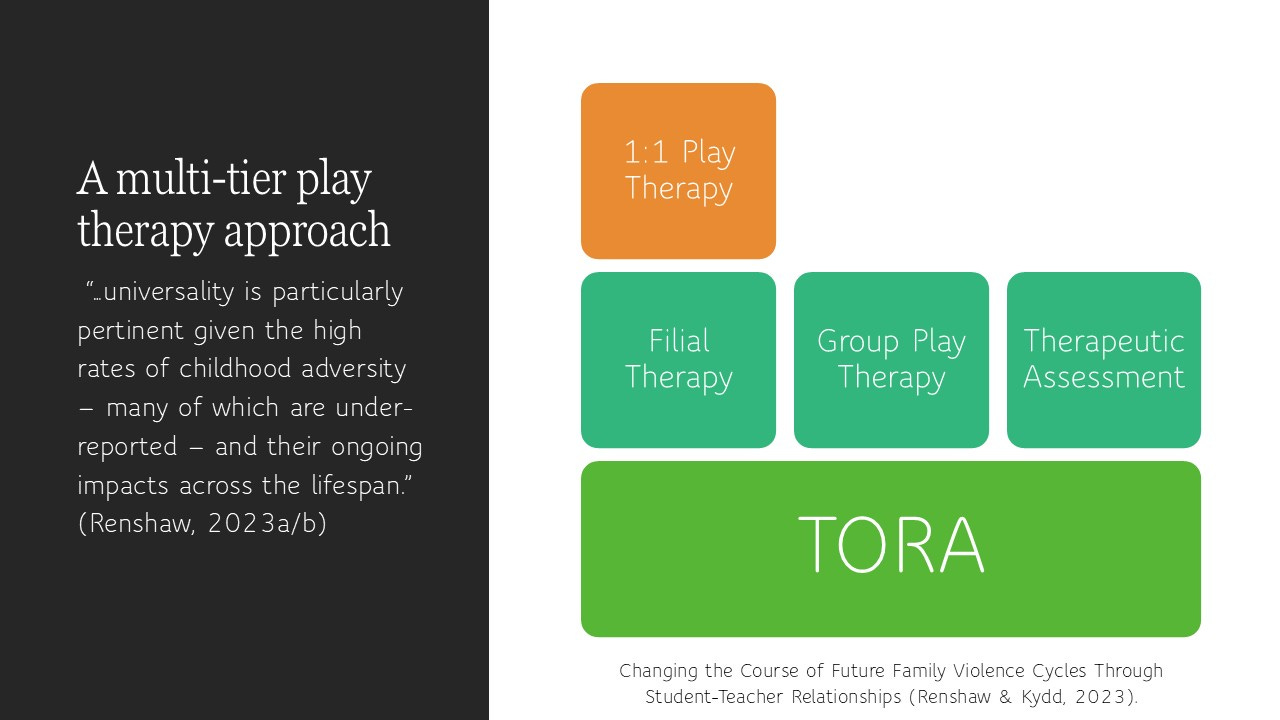
The MTPT framework is an organising framework. It maps the scope of different levels of play therapy practice — each of which carries its own evidence base — and anchors that scope to existing government policy architecture.
It is not itself an evidence-based intervention. Rather it makes visible the range of evidence-based play therapy practices, organises them into a coherent tiered structure, and shows where play therapy’s contribution sits within a whole system of support for children and families.
That distinction matters. The MTPT framework is valuable precisely because it organises and communicates scope — not because it is itself an intervention.
The policy alignment
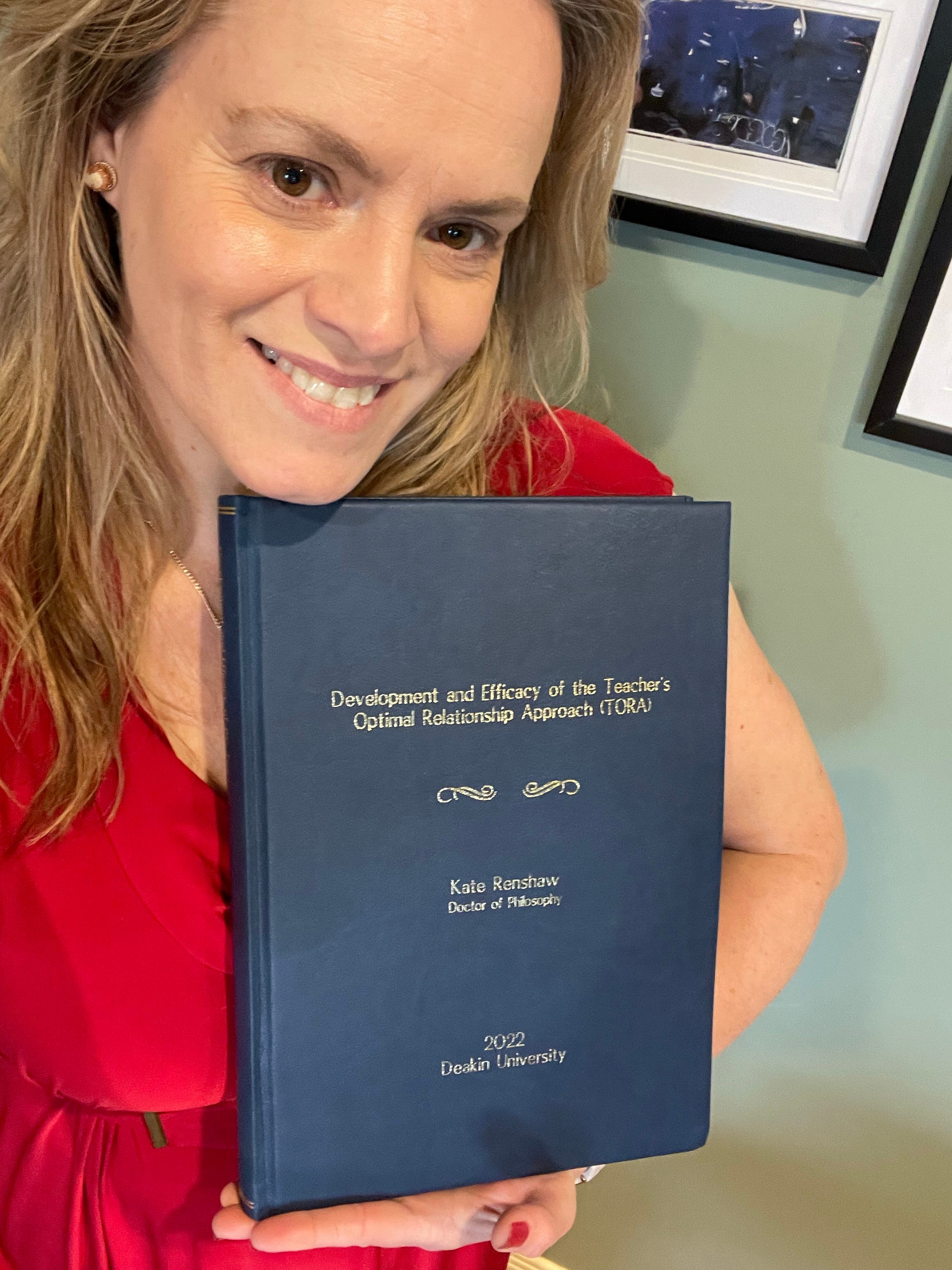
The MTPT framework was developed through doctoral research (2014–2022) and formally articulated in the PhD thesis Development and Efficacy of the Teacher’s Optimal Relationship Approach (TORA) (Renshaw, 2022). It maps explicitly onto the Victorian State Government’s mental health in schools funding model — a three-tier structure developed in response to the Royal Commission into Victoria’s Mental Health System (Victoria State Government – Education and Training, 2022).
That alignment was documented in the PhD thesis in 2022. It is not a retrospective claim. The MTPT framework doesn’t sit alongside government policy. It was developed with explicit reference to it.
The three-tier structure isn’t unique to mental health policy. Multi-tiered systems of supports (MTSS) are an established framework in education — used internationally and in Australia to scaffold student support across universal, targeted, and intensive tiers. The MTPT framework maps directly onto this structure. A play therapist working within MTPT is not introducing a new or unfamiliar logic to schools — they are working within the same organising framework that educators already use for academic, behavioural, and wellbeing support. That alignment is not incidental. It means play therapy’s contribution is legible to schools, education departments, and policy makers in a way that a purely clinical framework would not be. While developed with explicit reference to this education-based model, the MTPT framework's three-tier structure applies equally across other practice settings — clinical, community, and family contexts — wherever play therapy is delivered.
Three tiers. Three distinct contributions.
Tier 1 (Universal) — TORA (and adaptations CORA and ORA)
Universal approaches delivered by teachers, professionals in contextualised settings, and parents/caregivers. Available to all children. Delivered by trained non-therapists.
Play therapists are not absent from Tier 1. They are tertiary trained play therapists, highly skilled, who engage in TORA Facilitator training. With specialised post-qualifying training, they become the facilitators who train TORA Teachers, CORA Practitioners, or ORA Caregivers. They supervise the delivery of universal approaches. They are the expert foundation that makes Tier 1 possible — and they are the referral point when a child’s needs exceed what Tier 1 can provide.
TORA is an evidence-based universal approach — the first of its kind in play therapy, developed through doctoral research across Victorian schools, including two sole-authored practitioner guidebooks (2023).
Tier 2 (Targeted)
Group Play Therapy, Filial Therapy (spanning early intervention through to complex family support), and therapeutic assessment informed by evidence-based practice: for children with identified additional needs. Delivered directly by play therapists.
Filial Therapy at this tier works with parents and caregivers as the agents of therapeutic change for their children — an approach with a strong international evidence base that bridges family systems and child therapeutic need.
Tier 3 (Specialist/Intensive)
Individual Play Therapy, Filial Therapy at higher complexity, and therapeutic assessment at the complex end — including court-ordered assessments. The specialist clinical work the profession is most commonly associated with.
Play therapists at Tier 3 also collaborate systemically — with families, schools, and other professionals outside the playroom. However, the play therapy room is the centre of the therapeutic work, not its limit.
What the MTPT framework contributes to the SOP argument
The MTPT framework makes two things visible simultaneously.
First — the boundaries. It maps both the evidence-based interventions play therapists deliver and the evidence-based practice (EBP) they apply at each tier, and implicitly what falls outside their role. That boundary clarity is what SOP requires.
Second — the breadth. Play therapy is not a single-tier specialist service. A play therapist, with the required training, supervision and experience, can contribute at every tier of the system — as facilitator and supervisor at Tier 1; as direct practitioner at Tier 2; as specialist clinician at Tier 3.
That breadth sits alongside — not in competition with — the contributions of other allied health practitioners. Occupational therapists, psychologists, counsellors, and social workers all have roles within children’s mental health and developmental support. The MTPT framework doesn’t claim play therapy replaces those roles. It articulates what play therapy specifically contributes within a whole-system approach.
A scope of practice that only defines what play therapists don’t do undersells the profession. The MTPT framework makes the affirmative case.
The SOP conversation happening right now
The SOP conversation in play therapy is gaining momentum internationally. It is a necessary and important conversation.
But it needs to engage with the work that already exists. Australia already has a published, organising framework that maps play therapy’s scope of practice across a tiered system, aligned with government policy. The MTPT framework was formally articulated in 2022. It has been presented at domestic and international conferences. It is documented in peer-reviewed publications and practitioner guidebooks.
That contribution deserves to be part of the international SOP conversation.
The next post in this series will look at where Australia sits within the international play therapy professionalisation landscape — and what the path toward formal SOP recognition looks like.
![Multi-Tier Play Therapy (MTPT) framework diagram, © Dr Kate Renshaw, 2022. Three-tier pyramid: Tier 3 (Specialist/Intensive, navy) — Individual Play Therapy, Filial Therapy (complex/crisis), Therapeutic Assessment (complex end), role: specialist clinician; Tier 2 (Targeted, teal) — Group Play Therapy, Filial Therapy (early intervention through to complex family support), Therapeutic Assessment (informed by evidence-based practice, for children with identified additional needs), role: direct practitioner; Tier 1 (Universal, green) — TORA (Teacher's Optimal Relationship Approach) and CORA & ORA (Contextualised Optimal Relational Approach & Optimal Relationship Approach, adaptations of TORA), role: facilitator, trainer, supervisor. Left panel: "Aligned with: Victorian Schools Mental Health Fund (Royal Commission response); Multi-Tiered System of Supports (MTSS) in education." Callout: "Play therapists can contribute at every tier." Citation: Renshaw, K. (2022). Development and Efficacy of the Teacher's Optimal Relationship Approach (TORA) [Doctoral dissertation, Deakin University].](https://substackcdn.com/image/fetch/$s_!Zi6N!,f_auto,q_auto:good,fl_progressive:steep/https%3A%2F%2Fsubstack-post-media.s3.amazonaws.com%2Fpublic%2Fimages%2Fe5d30407-41c8-453c-8a13-58004a17e934_960x540.jpeg "Multi-Tier Play Therapy (MTPT) framework diagram, © Dr Kate Renshaw, 2022. Three-tier pyramid: Tier 3 (Specialist/Intensive, navy) — Individual Play Therapy, Filial Therapy (complex/crisis), Therapeutic Assessment (complex end), role: specialist clinician; Tier 2 (Targeted, teal) — Group Play Therapy, Filial Therapy (early intervention through to complex family support), Therapeutic Assessment (informed by evidence-based practice, for children with identified additional needs), role: direct practitioner; Tier 1 (Universal, green) — TORA (Teacher's Optimal Relationship Approach) and CORA & ORA (Contextualised Optimal Relational Approach & Optimal Relationship Approach, adaptations of TORA), role: facilitator, trainer, supervisor. Left panel: \"Aligned with: Victorian Schools Mental Health Fund (Royal Commission response); Multi-Tiered System of Supports (MTSS) in education.\" Callout: \"Play therapists can contribute at every tier.\" Citation: Renshaw, K. (2022). Development and Efficacy of the Teacher's Optimal Relationship Approach (TORA) [Doctoral dissertation, Deakin University].")
References
Australasia Pacific Play Therapy Association. (2014). Clinical competencies and practice standards for play therapy. Ratified at APPTA AGM, November 2014. https://appta.org.au/wp-content/uploads/2016/05/Clinical-competencies-and-Practice-Standards-ratified-at-AGM-Nov-2014.pdf
International Consortium of Play Therapy Associations. (2023, January). Play therapy education competencies and standards of practice. IC-PTA. https://www.ic-pta.com/_files/ugd/5e6137_52c97fa7529940e88b3d8f4703dc6429.pdf
Parson, J., Renshaw, K., & Zimmer, T. (2018). Play therapy hourglass [Visual schemata]. Deakin University. Presented at Foundational Concepts and Skills for Child Play Therapy short course, Deakin University Waterfront Campus, Geelong, Australia, November 26–27.
Renshaw, K. (2022). Development and efficacy of the Teacher’s Optimal Relationship Approach (TORA) [Doctoral dissertation, Deakin University]. Deakin Research Online.
Renshaw, K. (2023a). The Teacher’s Optimal Relationship Approach: TORA. Certified TORA facilitator guidebook for play therapists. Play and Filial Therapy Press.
Renshaw, K. (2023b). The Teacher’s Optimal Relationship Approach: TORA. A guidebook for certified TORA teachers. Play and Filial Therapy Press.
Renshaw, K., & Kydd, G. (2023, November 27-28). Changing the Course of Future Family Violence Cycles Through Student-Teacher Relationships [Conference presentation]. STOP Domestic Violence Conference, Hobart, Tasmania, Australia.
Sarah, B., Renshaw, K., Hadiprodjo, N., Godfrey, P., & Parson, J. (2023). Integrating the use of the Placement Assessment and Review (PAR) in play therapy supervision. In A. A. Drewes & J. A. Mullen (Eds.), Supervision can be playful: Techniques for child and play therapist supervisors (2nd ed., pp. 38–54). Rowman & Littlefield.
Victoria State Government — Education and Training. (2022). Victorian schools mental health fund and menu. Department of Education and Training.
About the Author
Dr Kate Renshaw (PhD, RPT-S™) is a play therapist, researcher, educator, author, and advocate with over 20 years of experience working therapeutically with children and families. She is the developer of the TORA and the Multi-Tier Play Therapy (MTPT) framework, and is the founding director of Play & Filial Therapy. Her work spans clinical practice, doctoral research, sole-authored practitioner guidebooks, parliamentary advocacy, and international conference presentations. She is based in Ballarat, Victoria, Australia.
🌐 playandfilialtherapy.com
💼 linkedin.com/in/drkaterenshaw